
When a Butterfly Flaps Its Wings In Brazil… and Causes a Tornado in Texas
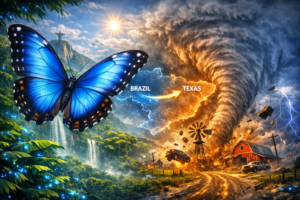 When a Butterfly Flaps Its Wings… There’s an old idea you’ve probably heard before—one that sounds more like a line from a fantasy novel than a principle of modern economics. It goes something like this: a butterfly flaps its wings in Brazil, and a tornado forms in Texas. Of course, butterflies aren’t secretly controlling the weather. But the metaphor captures something profound: small disturbances in complex systems can create large, unpredictable outcomes. Edward Lorenz, the MIT meteorologist who coined the phrase in the 1970s, discovered this while running weather simulations. He rounded a single number—just a few decimal places—and the entire forecast changed. That tiny adjustment, that “butterfly wing,” cascaded into a completely different outcome for his simulation. Lately, it feels like the global economy is living inside one of Lorenz’s weather models. But what Lorenz discovered wasn’t just a meteorological curiosity—it became the foundation of chaos theory, the study of how complex systems behave in ways that are highly sensitive to initial conditions. Markets operate the same way. A small policy shift in Washington, a surprise headline out of the Middle East, a sudden move in oil futures, or even an unexpected earnings comment from a Fortune 500 CEO can ripple through the system and create outsized market reactions. In investment management, we don’t try to predict these micro‑disturbances—that’s impossible. Instead, we build portfolios that accept the reality of chaos. Diversification, factor balance, liquidity management, and disciplined rebalancing are all ways of acknowledging that markets are nonlinear, interconnected, and occasionally turbulent. Chaos theory teaches us that while we can’t forecast every butterfly wing, we can design portfolios that remain resilient no matter which direction the wind blows. A drone strike here. A tanker seized there. A surprise policy comment from the Federal Reserve. A sudden spike in oil prices. A new A.I. breakthrough. A geopolitical flare‑up in a region most investors couldn’t find on a map. Each of these events is its own butterfly wing. And together, they’ve created a market environment that feels turbulent, uncertain, and—at times—uncomfortably unpredictable. But as I’ll explain, unpredictability is not the enemy of long‑term investing. In fact, it’s the very reason long‑term investing works. The Middle East Conflict: The Latest Butterfly Wing The ongoing conflict in the Middle East has been the primary driver of recent market swings. Brent crude oil has surged back above $110 per barrel, and with it comes a familiar set of questions:
These concerns are legitimate. Energy is the lifeblood of the global economy. When oil spikes, it doesn’t just affect your next fill‑up at the gas station. It affects everything—transportation, manufacturing, agriculture, logistics, and ultimately, consumer prices. But here’s the key point: none of this is new. Markets have weathered oil shocks before—1973, 1979, 1990, 2008, 2022—and each time, investors who stayed disciplined were rewarded. Today’s situation is different from the 1970s for one crucial reason: The United States is now the world’s largest producer of oil and natural gas. That doesn’t eliminate volatility, but it does provide a stabilizing force at home that didn’t exist during the Arab oil embargo of the 1970s. In 2022, when gas prices at the pump hit $5.00 per gallon, well above where they are today, inflation surged and recession fears dominated headlines. And yet, portfolios performed exceptionally well in the years that followed as markets recovered. The Temptation to “Do Something” When markets swing sharply, the natural instinct is to react. Adjust the portfolio. Raise cash. Rotate sectors. Hedge. Tinker. “Do something.” But here’s the truth that decades of research — and decades in the market– have taught me: By the time a crisis hits the headlines, the hard work of portfolio construction has already been done. A well‑built portfolio is like a well‑built house. You don’t start reinforcing the foundation when the hurricane is already overhead. You build it strong from the beginning so it can withstand storms without constant intervention. This is why our D.I.C.E.™ strategy has worked so well over the years. It’s not reactive. It’s not tactical. It’s not driven by headlines. It’s driven by structure, discipline, and diversification across:
This framework is intentionally designed to weather unpredictable environments—because unpredictable environments are the norm, not the exception. Last week a client called me to ask if we should hedge our portfolios because of the recent market volatility caused by the Iran War. I explained that we were already “hedged” because the diversification of our D.I.C.E.™ strategy acts as a natural hedge, smoothing out returns over time yet arriving at the same endpoint. Market Pullbacks: A Feature, Not a Bug The S&P 500 recently experienced its first 5% pullback of the year. For many investors, this felt jarring—especially after the strong performance in 2024 and 2025. Pullbacks are not a sign that something is wrong. They are a sign that markets are functioning normally. But let’s put this year’s market in perspective:
This is why market timing is so difficult. You don’t just have to know when to get out—you must know when to get back in. And the rebound often happens before investors feel emotionally ready to re‑enter the market. Gas Prices: The Most Visible Economic Indicator While stock market volatility may get the most headlines, the most tangible impact of the Middle East conflict has been at the gas pump. The national average for regular unleaded recently hit $4.00 per gallon, up more than a dollar in a month. And depending on where you live, the real price you pay may be even higher. No one enjoys paying more for gas. It’s a non‑negotiable expense, and it leaves less room for discretionary spending. But for most households, it’s an inconvenience—not a crisis. You’re not going to cancel your family’s summer vacation to the beach because you have to spend an extra $10 per fill‑up. But it may cause you to pass up your next Starbucks vente mocha Frappuccino. More importantly, we’ve seen this movie before. In 2022, gas prices were significantly higher, and yet:
Higher gas prices are a headwind, not a catastrophe. The Broader Market Landscape: A.I., Valuations, and the Fed While the Middle East dominates the headlines, several other forces are shaping markets: 1. Artificial Intelligence A.I. continues to transform industries, reshape corporate strategies, and drive capital investment. Semiconductors remain the “new oil,” powering everything from cloud computing to robotics to autonomous systems. Our exposure through DTCR, CHAT, SOXX, SMH, Microsoft, Intel, Seekr Technologies, Teradyne, and Tesla reflects our conviction that we are still early in the A.I. adoption cycle. 2. Market Valuations Valuations are elevated in certain sectors—particularly megacap technology—but far more reasonable in others. This is why diversification across factors, sectors, and geographies remains essential. It’s also why we are focusing on the Invesco equal‑weight S&P 500 ETF, ticker symbol RSP, to reduce our exposure to the Magnificent Seven. 3. Federal Reserve Policy The Fed remains data‑dependent, balancing inflation risks with economic stability. Rate cuts may come later than expected, but the direction of travel remains downward. None of these forces operate in isolation. They interact—sometimes constructively, sometimes chaotically—like Lorenz’s butterfly weather models. Why Your Portfolio Is Built for This Moment The past few weeks have highlighted the power of a properly constructed and diversified portfolio.
This is not about guessing what asset class or sector will outperform next. It’s about ensuring that something in the portfolio is always working, even when other areas struggle. Our D.I.C.E.™ strategy was built for exactly this type of environment—one defined by volatility, opportunity, and structural change. A Few Reminders During Uncertain Times 1. Markets have no memory. They don’t care what happened last week or last month. They respond to new information, new risks, and new opportunities. We want to use our 40 years of market experience to look around corners, not in the rear‑view mirror. 2. Volatility is not the enemy. It is the price of admission for long‑term returns. We simply aim to smooth out our D.I.C.E.™ returns so they are less volatile and therefore superior returns on a risk‑adjusted basis. 3. Staying invested is historically the best strategy. Missing just a handful of the market’s best days can dramatically reduce long‑term returns, and these up days usually occur right after a dramatic market sell-off. 4. Your financial plan already accounts for moments like this. We don’t build portfolios for calm seas. We build them for gale storms. (See what I did there?) Let’s return to our butterfly. When Lorenz first presented his findings, many scientists resisted the idea that tiny disturbances could create massive, unpredictable outcomes. It felt too chaotic, too random, too unsettling. But over time, the butterfly effect became a foundational principle of modern science of chaos theory. Not because it predicts the future, but because it acknowledges the limits of prediction. Investing works the same way. We cannot predict which butterfly wing—geopolitical, economic, technological, or emotional—will flap next. We cannot predict which headlines will move markets tomorrow. We cannot predict which sector will lead or lag in the next quarter. But we can build portfolios that are resilient to uncertainty. We can stay disciplined when others panic. We can focus on long‑term goals rather than short‑term noise. And we can trust the process we’ve built together as partners at Double Eagle Partners. Your portfolio is designed precisely for environments like this one. Not despite the uncertainty—but because of it. So, the next time you hear about a drone strike, a Fed comment, a spike in oil prices, or a sudden market swing, remember the butterfly. Remember that small disturbances are part of the system, not a sign that the system is broken. And remember that your financial plan is built not for perfection, but for resilience. Thank you, as always, for your trust. |
 |
Written by Jim Claire